
by Diana
It’s an interesting time for the ITM as an organisation, and for us as ITM teachers. Last year we had to deal with the shocking news of the sudden death of our founder, Don Weed. I’ve watched both the teachers and the organisation adjust, rising to this new challenge by employing the training that Don gave us. This seems an appropriate time and place to say something about him and his work.
If you’ve read my ‘Meet the Teacher’ biography, you’ll know I’m a bit of an academic type. Although I no longer work in universities, teaching and learning remain fundamental to my life. Not a day goes by when I am not engaged in these activities, be that via formal studying, simply trying to understand a new or tricky concept or idea, learning a new skill or improving an old one, engaging in discussion with friends or family, or passing on knowledge or skills to other people.
When I met Don in 2011 it was via his role as a teacher. I was fortunate to be able to spend the next nearly eleven years as a student of his. I have long regarded him as the best teacher I have ever known – which after three schools, three universities, and 26 years in formal education, is not a small number of people!
This is the address I read at Don’s funeral:
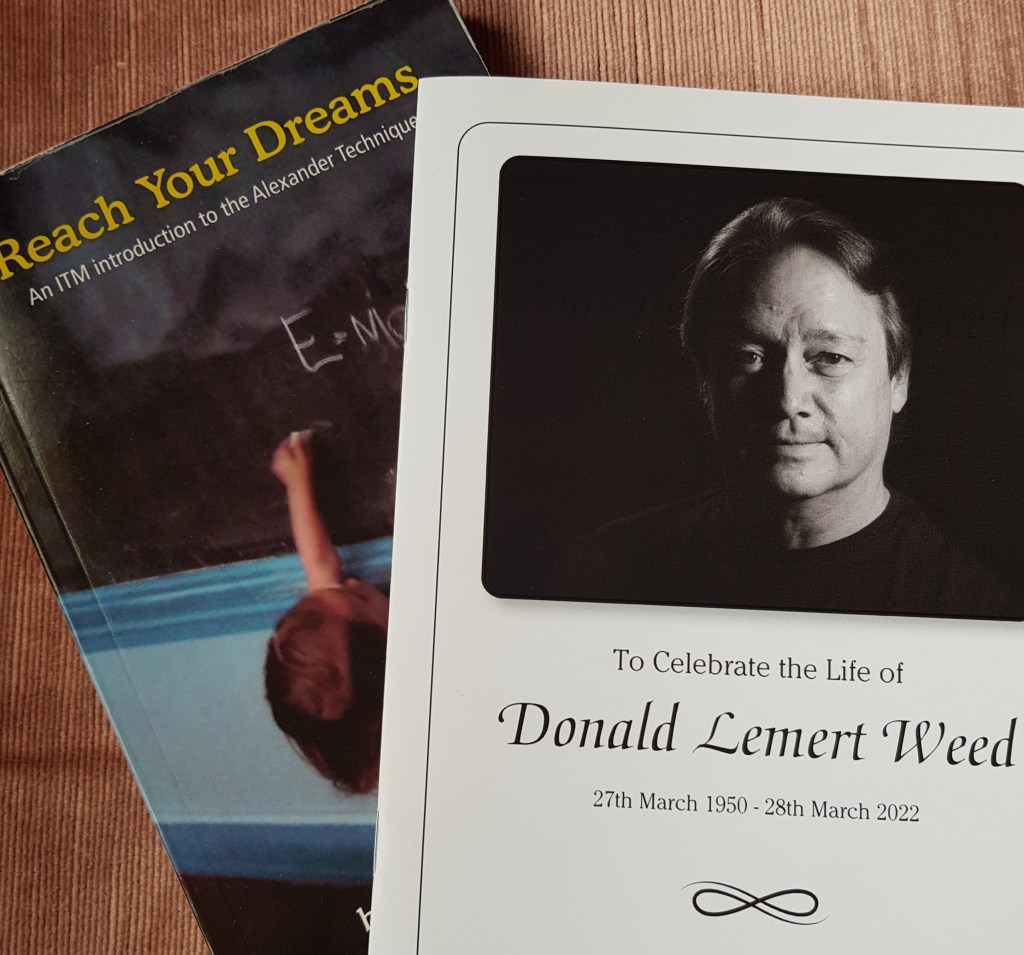
When my brother, David, persuaded me to give ITM a try back in 2011, one of the things he said was that having Don’s influence, not only in my life, but in my daughters’ lives too, would be profoundly beneficial. He was absolutely right. I’ve used the skills, the tools, and the knowledge gleaned from ITM consistently both for myself and for my daughters. I know there are hundreds of people who can say the same, which I think is testament to a life well lived.
I’ve had dozens teachers in my life: 3 schools, 3 universities, and teachers on many other courses, formal and informal. Don was not just the best. He was light years ahead of any other teacher I’ve ever had. I teach many things now in addition to Alexander’s work, all on ITM principles. I have learnt a lot about how to teach and how to be an effective student, too. These are priceless gifts.
After my dad’s death I found the copies of Don’s books that David had given him. They have all my dad’s margin notes written in them. It’s like seeing a conversation between Don and my dad. I’m sure you can imagine how special that is.
The things I will remember and cherish the most are Don’s extraordinary generosity to me and my family, and how very kind he always was. Kindness does not always look, or feel, like kindness because we mistake kindness for being given what we want. Don did better than that by caring enough to give us what we needed. I will always be grateful for that. And … the humour. I loved the humour.
I am profoundly grateful to have had the opportunity to be part of Don’s orbit for the last decade or so.
This is such a small number of words to try to capture a man who had a profound influence on all who cared to learn with him. Fortunately, there were many who spoke both during and after his funeral, and between us all we managed to capture something of the totality of his personality and impact on the world.
Don, as a teacher, could provoke strong reactions in people. He was described by some as a “Marmite personality.” I think that’s a fair description of people’s initial reaction to him. Those who stayed to learn from him could have very different experiences too: whether you relish being challenged, or whether you find it difficult, Don consistently presented the challenge that he judged would best help us progress. It’s not always a comfortable position to be in. But as someone who’s been in that position, who has had times where challenge was welcomed and times where challenging myself was horribly painful and excruciatingly difficult, my conclusion is that it has always been worth it when done in a reasoned and compassionate way.
That’s how I like to remember Don. It’s easy to fall into the cosy recollections of all the fun and the laughter we had in his classroom. It’s a wonderful, and essential, part of the ITM approach to teaching. But what I really value is that Don cared about each of us enough to do the hard work, to give us the challenge we needed, and to use his finely-honed skills as a master teacher to help us do the work required in order to grow.
Don sometimes described an ITM Alexander Technique lesson as “an arena where the student’s ideas fight for survival.” Sometimes that fight is nothing more than a scuffle. Sometimes it’s a comedy. Sometimes it’s cerebral, and sometimes it’s more like a pratfall. But sometimes it’s visceral. Sometimes it feels brutal. And through every type of interaction from the funny to the fundamental via the forbidding, Don was willing and able to carry us. And he taught us how to carry ourselves through the challenge that is letting go of our self-imposed limitations. He couldn’t have given a greater gift.

 Wessex Alexander Technique